
Business Car Leasing Tax Benefits Explained: A UK Guide for 2027
Published: 17 November 2026 | By Aaron Walker | Applied Leasing – UK Vehicle Leasing Specialists
What are the tax benefits of business car leasing in 2027?
Business car leasing can offer UK limited companies, sole traders and fleet operators potential VAT recovery, tax-deductible expenses and more predictable vehicle costs.
However, the tax relief available depends on your business structure, VAT registration, vehicle emissions, private use and the type of finance agreement.
Electric company cars can also offer relatively favourable Benefit-in-Kind (BiK) tax treatment for employees and directors, although the rates are increasing over the coming years.
At Applied Leasing, we've been helping UK businesses and drivers explore vehicle leasing options since 1990. This guide explains the main tax considerations, with practical examples to help you understand how the rules may apply.
1. Business Car Leasing Tax Benefits at a Glance
Four key figures to understand
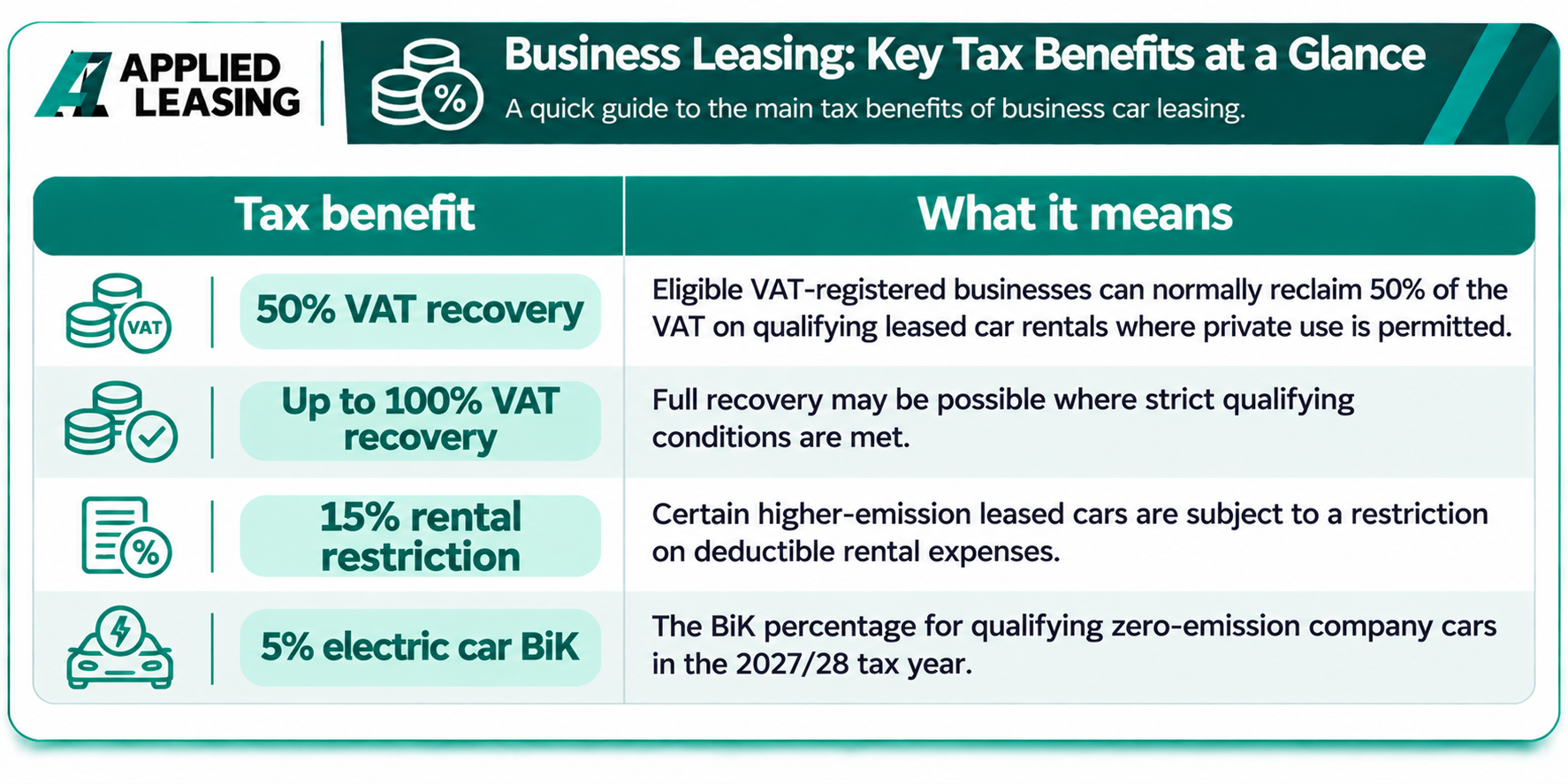
Important: These are general UK tax rules, not guaranteed savings. Eligibility depends on individual business circumstances.
For more information about the agreement itself, explore our Business Contract Hire guide.
2. Can You Reclaim VAT on Business Car Leasing?
For VAT-registered businesses, VAT recovery can be one of the main financial considerations when choosing Business Contract Hire.
Under HMRC rules, eligible businesses can normally recover 50% of the VAT charged on qualifying leased car rentals, provided they meet the usual VAT recovery requirements.
The remaining 50% is generally restricted to account for private use. Other restrictions, such as partial exemption, may reduce the amount recoverable.
Example: £300 + VAT Monthly Business Lease
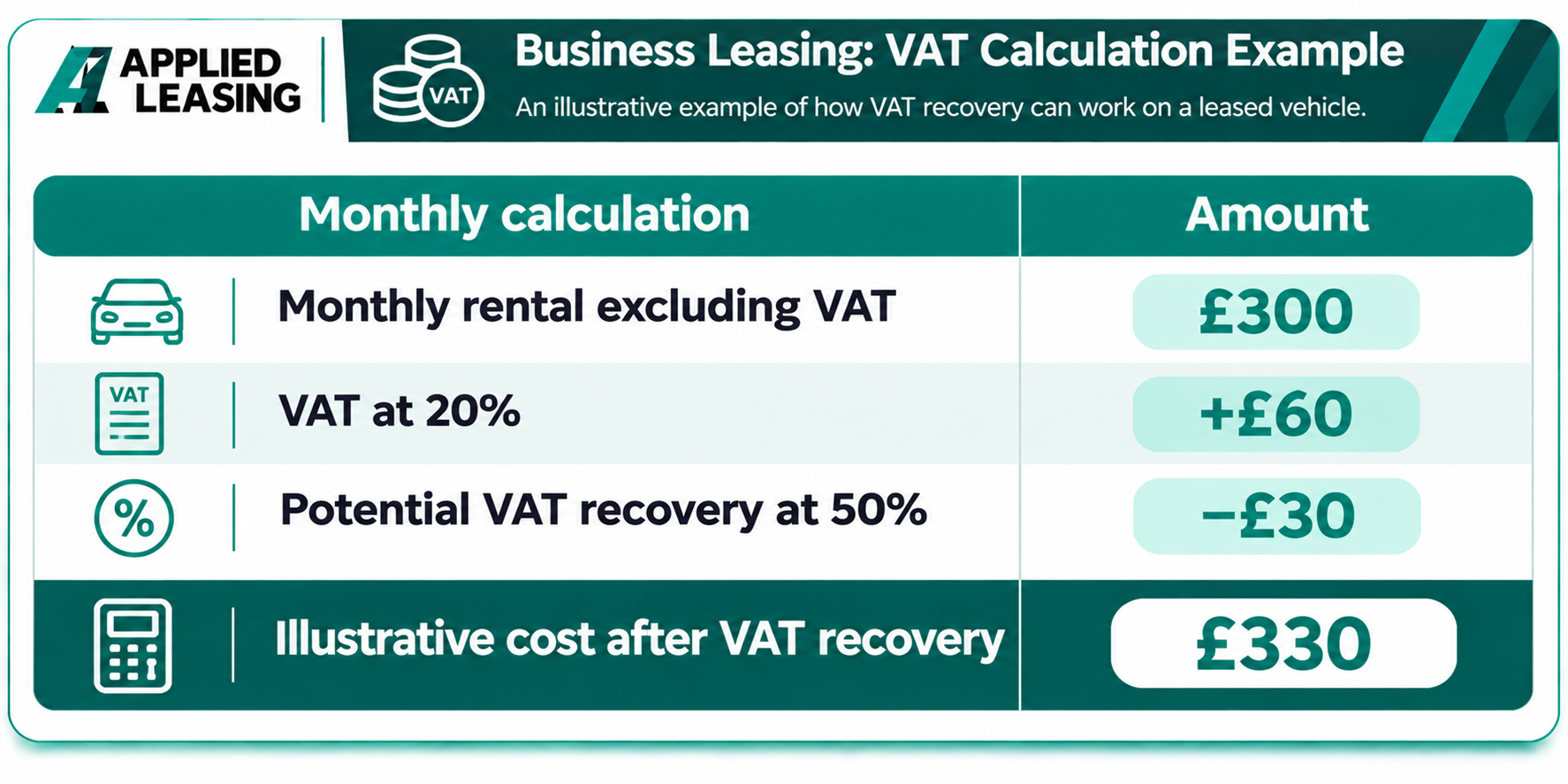
£300 + £60 − £30 = £330 per month
This is the illustrative rental cost after VAT recovery, before Corporation Tax relief or other expenses.
Over 36 equivalent rental payments, the potential VAT recovery would total £1,080.
Actual agreements may have a larger initial rental, different subsequent rentals and additional charges.
Can a Business Recover 100% of the VAT?
In certain circumstances, full VAT recovery may be available where a qualifying leased car is used exclusively for business purposes and is not available for private use, or where it meets other specific HMRC qualifying conditions, such as qualifying taxi or driving-instruction use.
The rules are strict, and eligibility depends on the vehicle's use, leasing arrangement and business circumstances.
Businesses should confirm their eligibility with a qualified accountant or tax adviser.
What About VAT on Maintenance?
VAT on separately identified maintenance services may be recoverable under normal input tax rules, subject to business use and other applicable restrictions.
Where a contract includes maintenance, the invoices and the way services are supplied should be checked.
Official source: HMRC – VAT on Motoring Expenses
3. Is Business Car Leasing Tax-Deductible?
Qualifying business lease rental expenses can generally be deducted when calculating taxable business profits, subject to the applicable rules.
For a limited company, allowable expenses may reduce the profits on which Corporation Tax is calculated.
However, not every leasing payment or charge is automatically fully deductible.
How CO₂ Emissions Affect Tax Deductions
HMRC applies a restriction to the deduction for certain leased cars with CO₂ emissions above 50g/km.
For relevant agreements, 15% of the rental expense may be disallowed when calculating taxable profits.
This means the business may generally deduct 85% of the relevant rental expense rather than the full amount.
Example: £4,000 Annual Business Lease Rental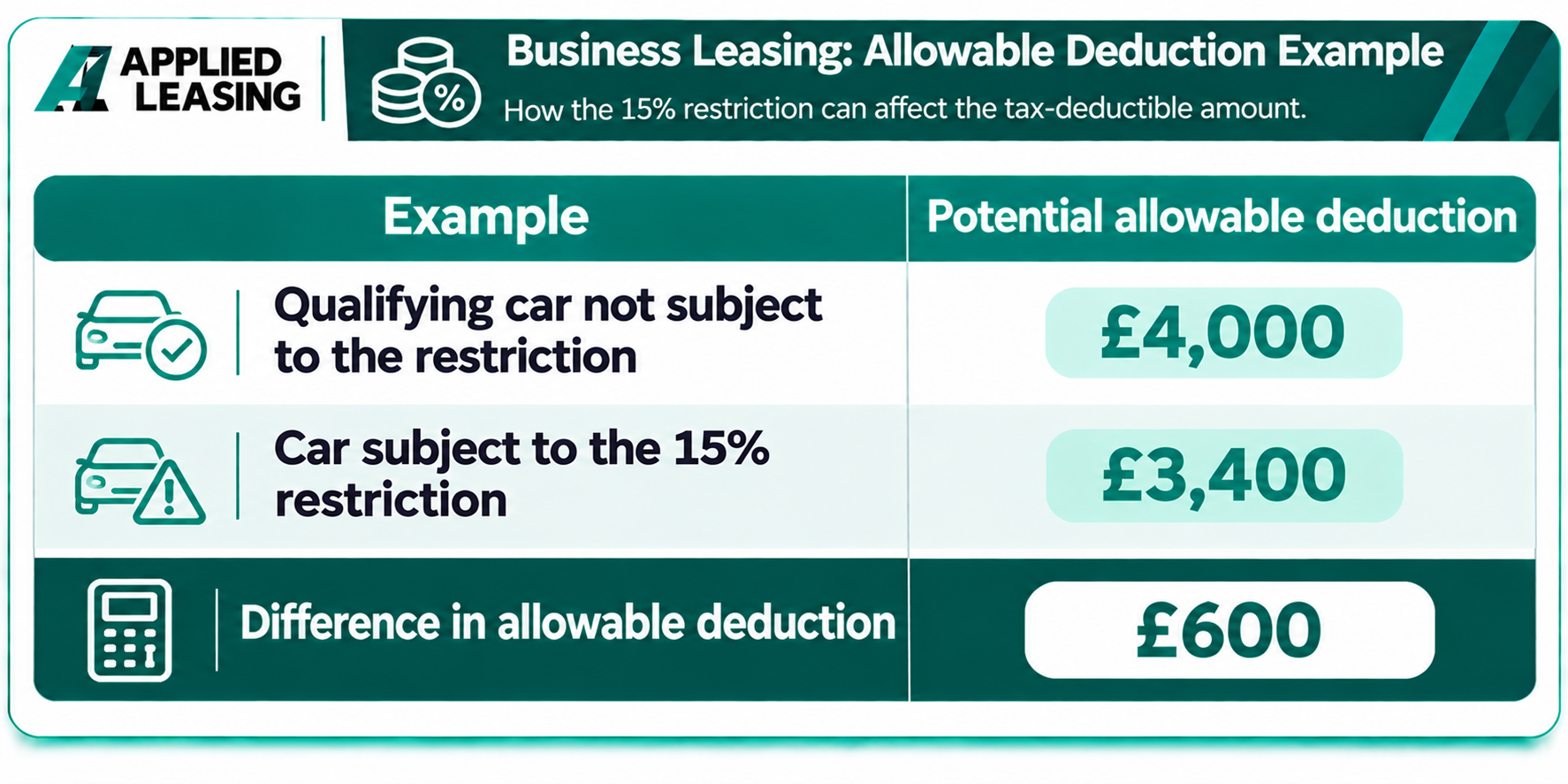
The restriction can also affect relevant irrecoverable VAT, while separately identified maintenance charges are generally excluded from the calculation.
What Could This Mean for Corporation Tax?
Assuming a company obtains tax relief at an illustrative 25% Corporation Tax rate:
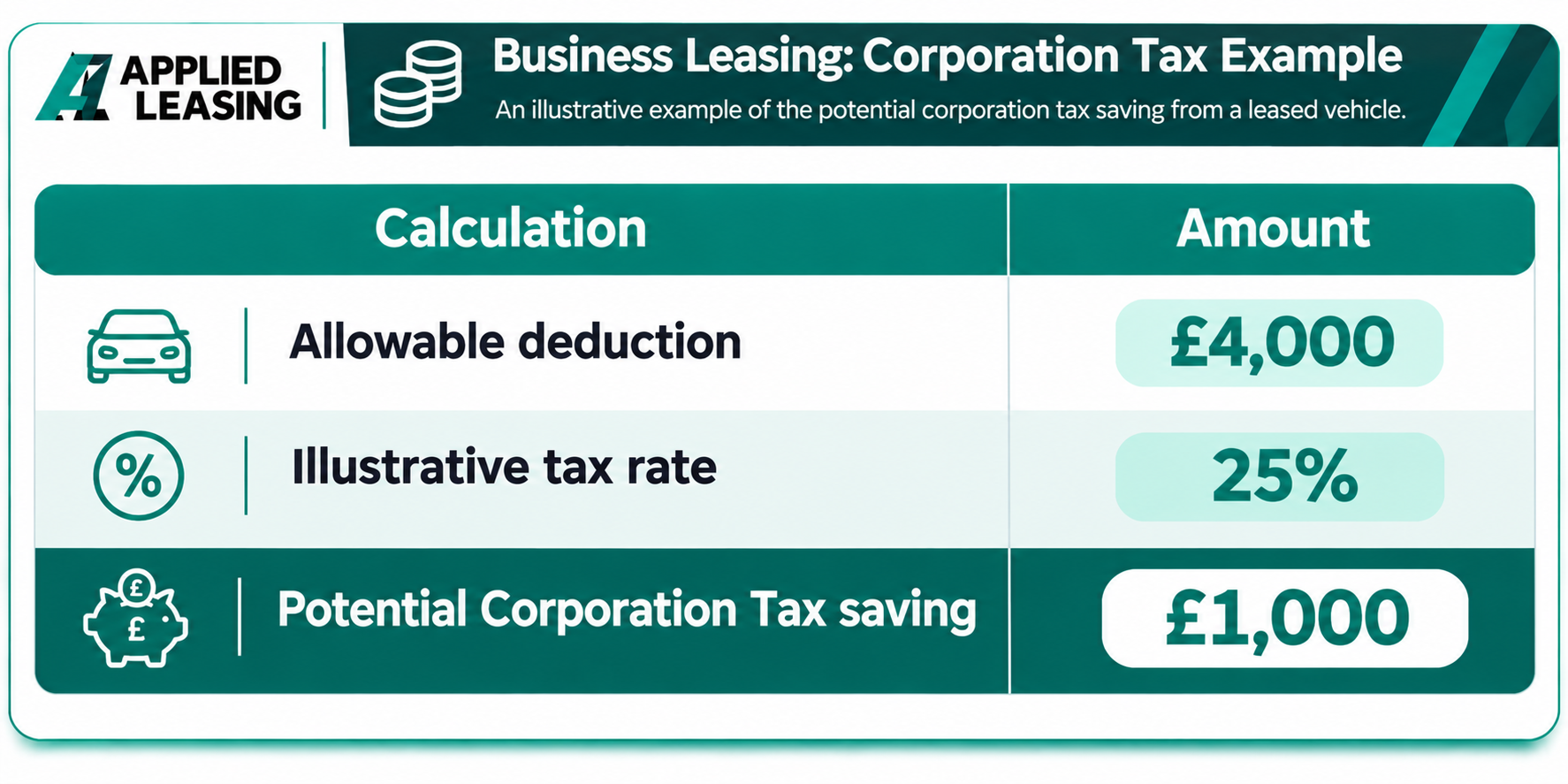
This assumes sufficient taxable profits and no other relevant adjustments. The actual saving depends on the company's applicable Corporation Tax rate and circumstances.
Official source: HMRC – Restrictions on Car Hire Costs
4. Are Electric Cars More Tax-Efficient for Businesses?
Electric vehicles can be attractive for businesses because they produce no tailpipe CO₂ emissions and can qualify for favourable company car tax treatment.
For qualifying fully electric cars, the 15% rental deduction restriction relating to higher CO₂ emissions would not normally apply.
Electric vehicles may also offer lower energy costs when charged using competitively priced electricity.
However, charging arrangements, lease rentals, insurance and vehicle suitability should all be considered when comparing overall costs.
Electric Company Car Benefit-in-Kind Rates
When a company car is available for private use by an employee or director, a taxable benefit can arise.
For qualifying zero-emission company cars, the legislated and announced BiK percentages are:
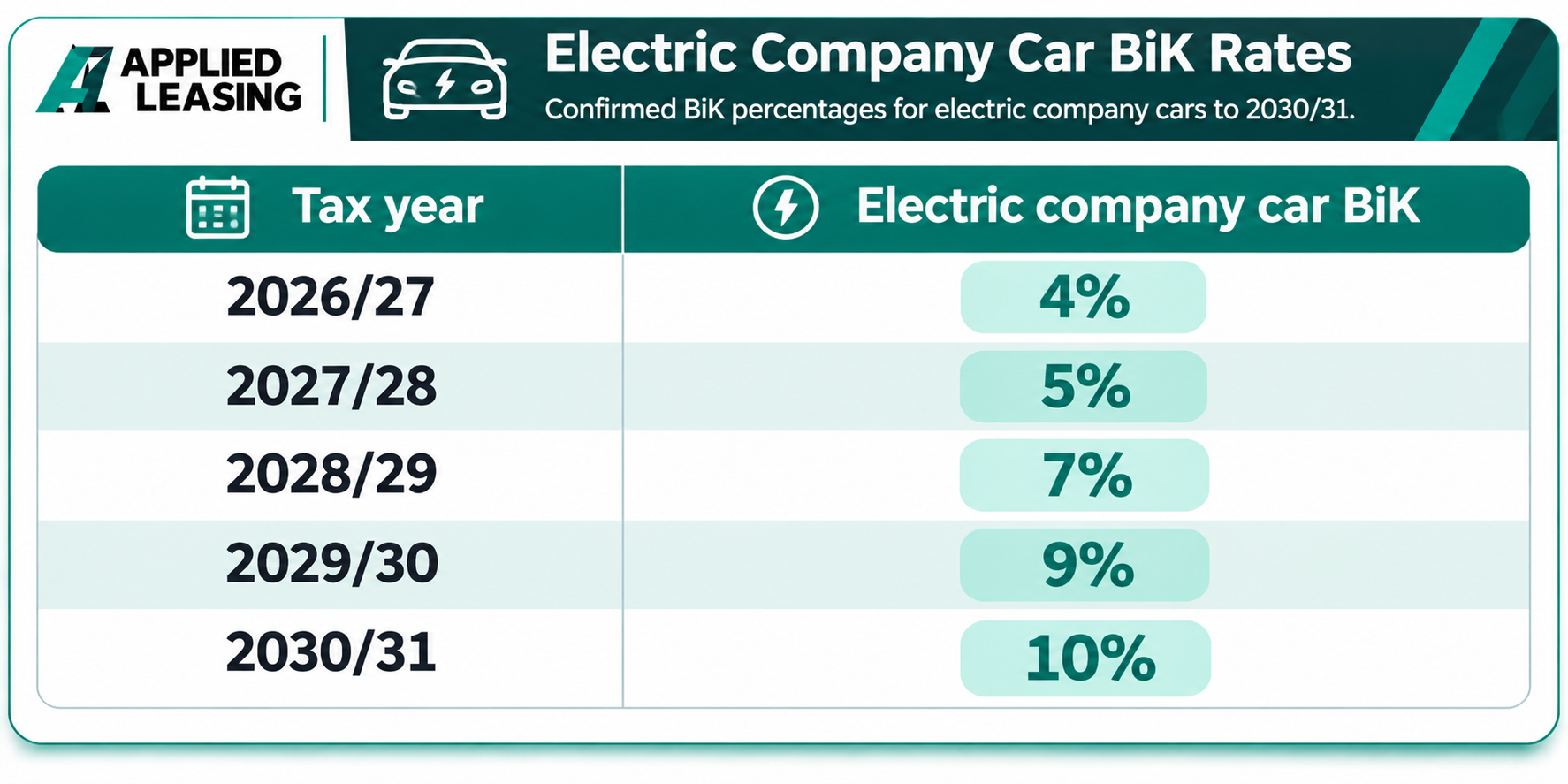
The 2030/31 rate was announced in Budget 2026 and remains subject to the relevant legislation.
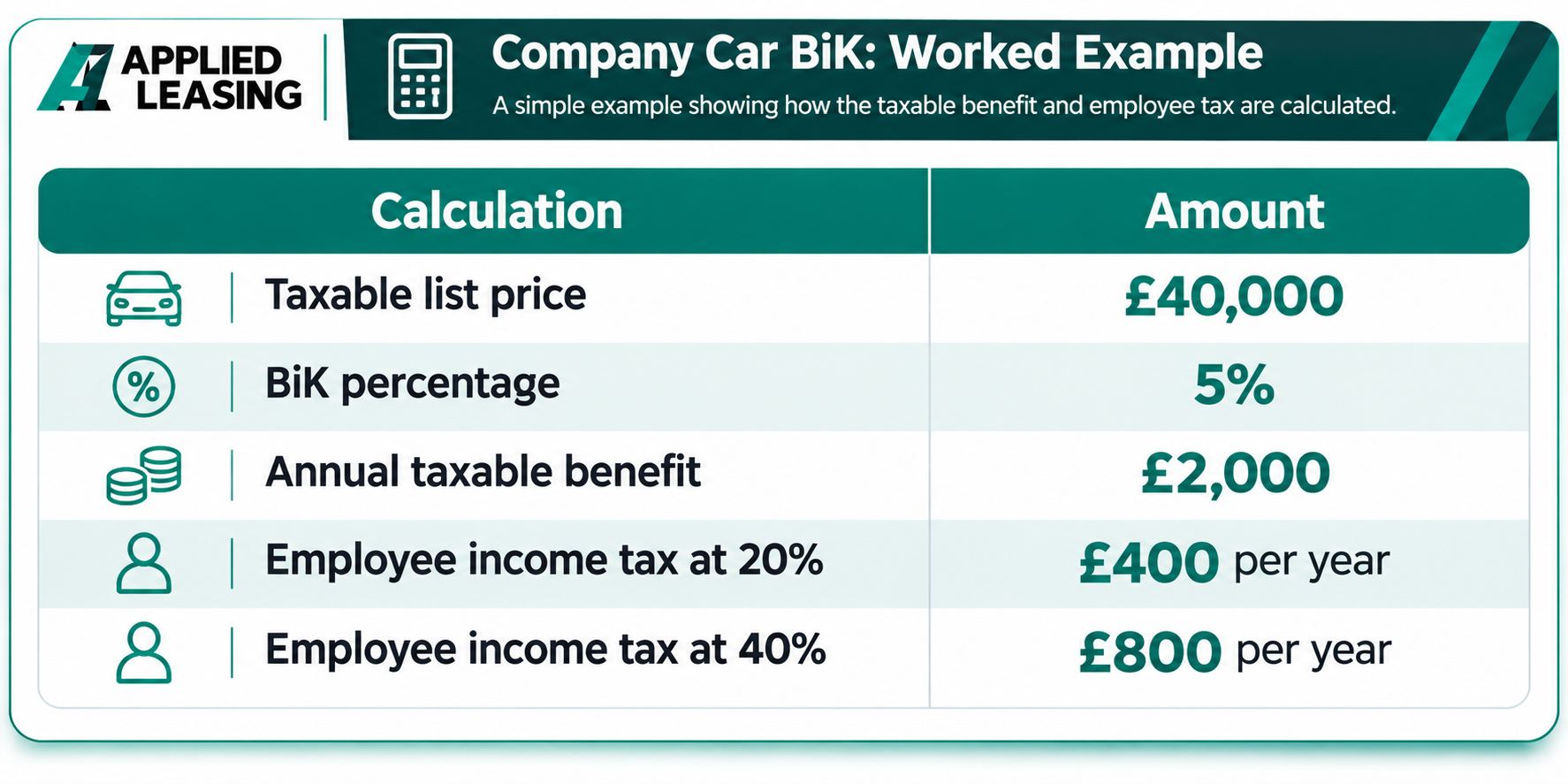
The percentages generally apply to the vehicle's taxable list price, including relevant accessories, rather than its monthly lease rental.
Example: £40,000 Electric Company Car in 2027/28
What Could That Cost Per Month?
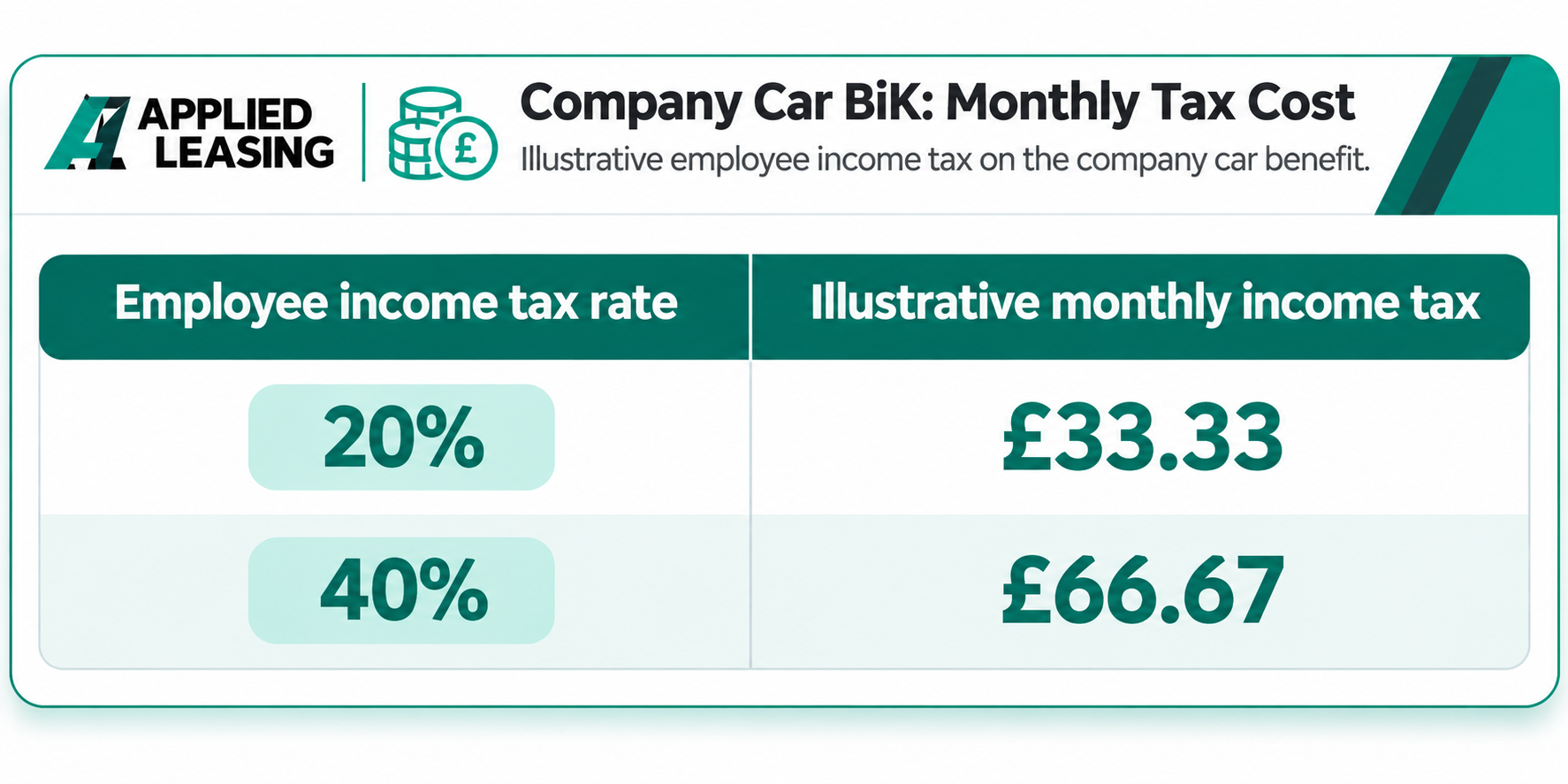
These examples assume the stated income tax rates apply to the entire taxable benefit and exclude any additional effects of the employee's individual circumstances.
Employers should also consider applicable Class 1A National Insurance contributions on taxable company car benefits.
Official source: HMRC – Company Car Tax Rates
For a broader look at electric vehicle costs, read our Is Electric Car Leasing Still Worth It in 2027? guide.
You can also explore our Electric Vehicle Leasing options.
5. What About Petrol, Diesel and Hybrid Company Cars?
Petrol, diesel and hybrid vehicles may still be suitable for many businesses, depending on mileage, journey requirements and available charging infrastructure.
However, their tax treatment can differ from fully electric cars.
Company car BiK percentages depend on factors such as CO₂ emissions, fuel type and, for some plug-in hybrid vehicles, electric-only driving range.
A higher BiK percentage can increase the employee's personal tax liability.
How Different BiK Percentages Affect Tax
Using an illustrative £40,000 taxable list price:
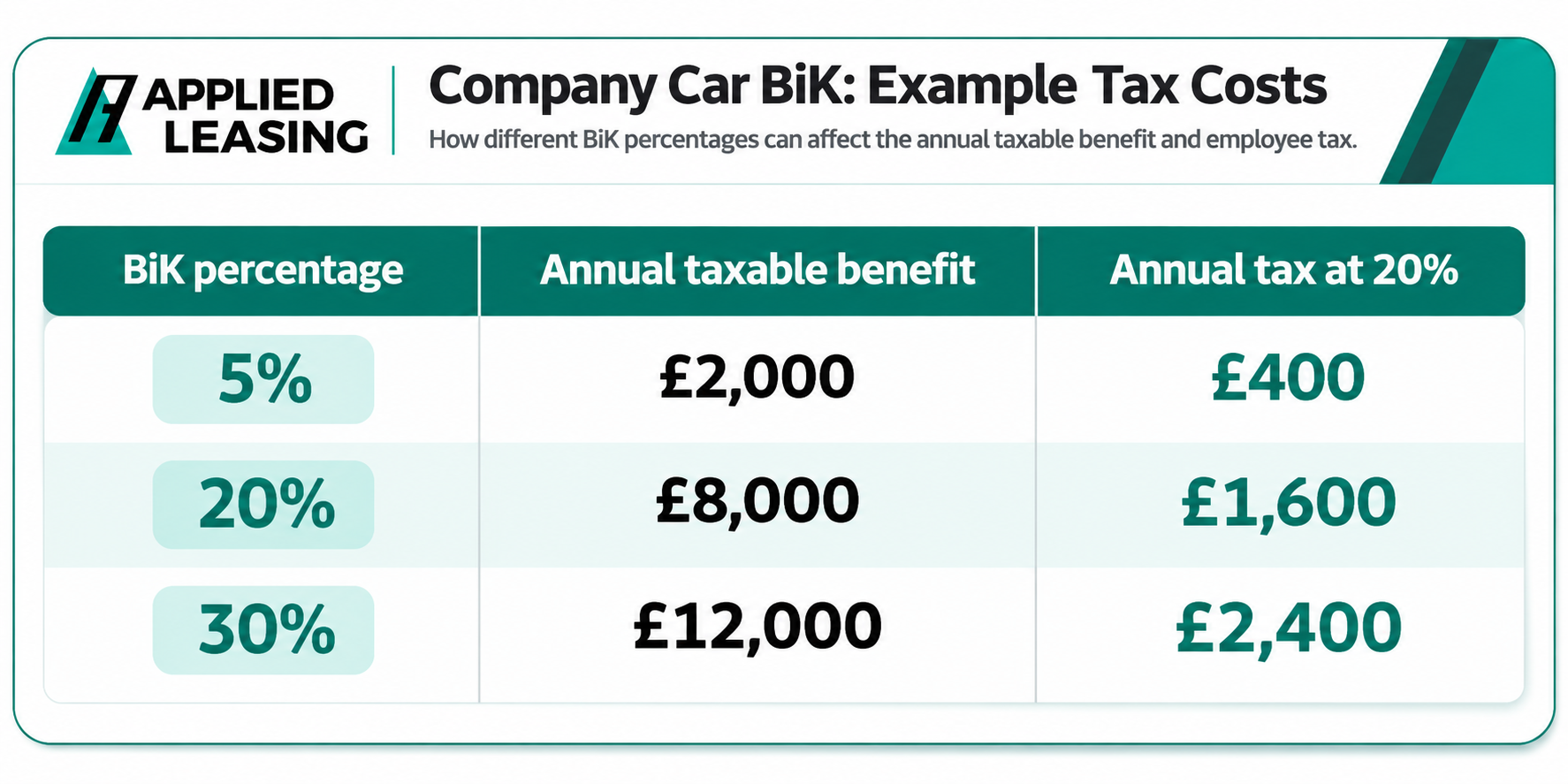
These are mathematical illustrations, not rates assigned to specific petrol, diesel or hybrid models.
Businesses should check the appropriate percentage for the exact vehicle and tax year.
6. Is Business Leasing Better Than Buying for Tax Purposes?
There is no universal answer.
With Business Contract Hire, qualifying rental expenses may be deductible when calculating taxable business profits, subject to the relevant restrictions.
When purchasing a vehicle, different tax rules may apply, including capital allowances and the treatment of finance costs.
Leasing vs Buying: Key Differences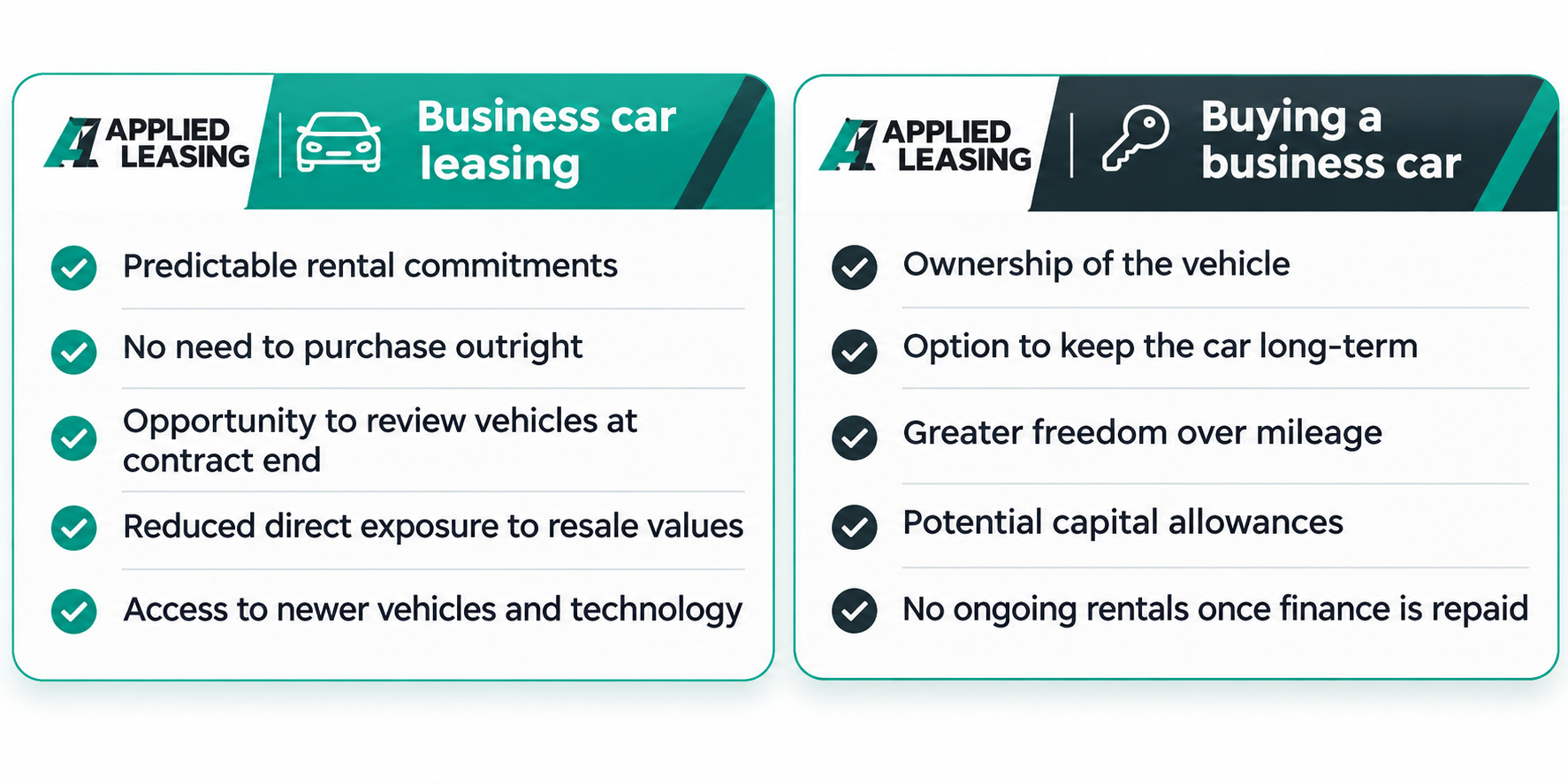
Applied Leasing insight: The best decision should consider cash flow, total costs, available tax relief and how long the business intends to use the vehicle.
For a more detailed comparison, read our Car Leasing vs Buying: Which Is Cheaper in 2027? guide.
7. Can a Sole Trader Claim Tax Relief on Car Leasing?
Sole traders may be able to claim qualifying business-related vehicle costs, but the position differs from that of a limited company.
Where a car is used for both business and private journeys, sole traders using the actual-expenses method can generally claim only the allowable business proportion of qualifying costs, subject to the relevant tax rules.
The treatment may also depend on whether the sole trader uses actual vehicle expenses or an eligible simplified mileage method.
You generally cannot claim both simplified mileage expenses and the same underlying vehicle costs.
VAT recovery, where applicable, is a separate consideration.
Important: Travel between home and a permanent workplace is not normally treated in the same way as qualifying business journeys.
Sole traders should confirm which expense method is appropriate for their circumstances with a qualified accountant or tax adviser.
8. Can a New Limited Company Lease a Car?
A newly established limited company may be able to obtain a Business Contract Hire agreement.
However, approval is subject to the finance provider's eligibility criteria and credit assessment.
What Might a Finance Provider Consider?
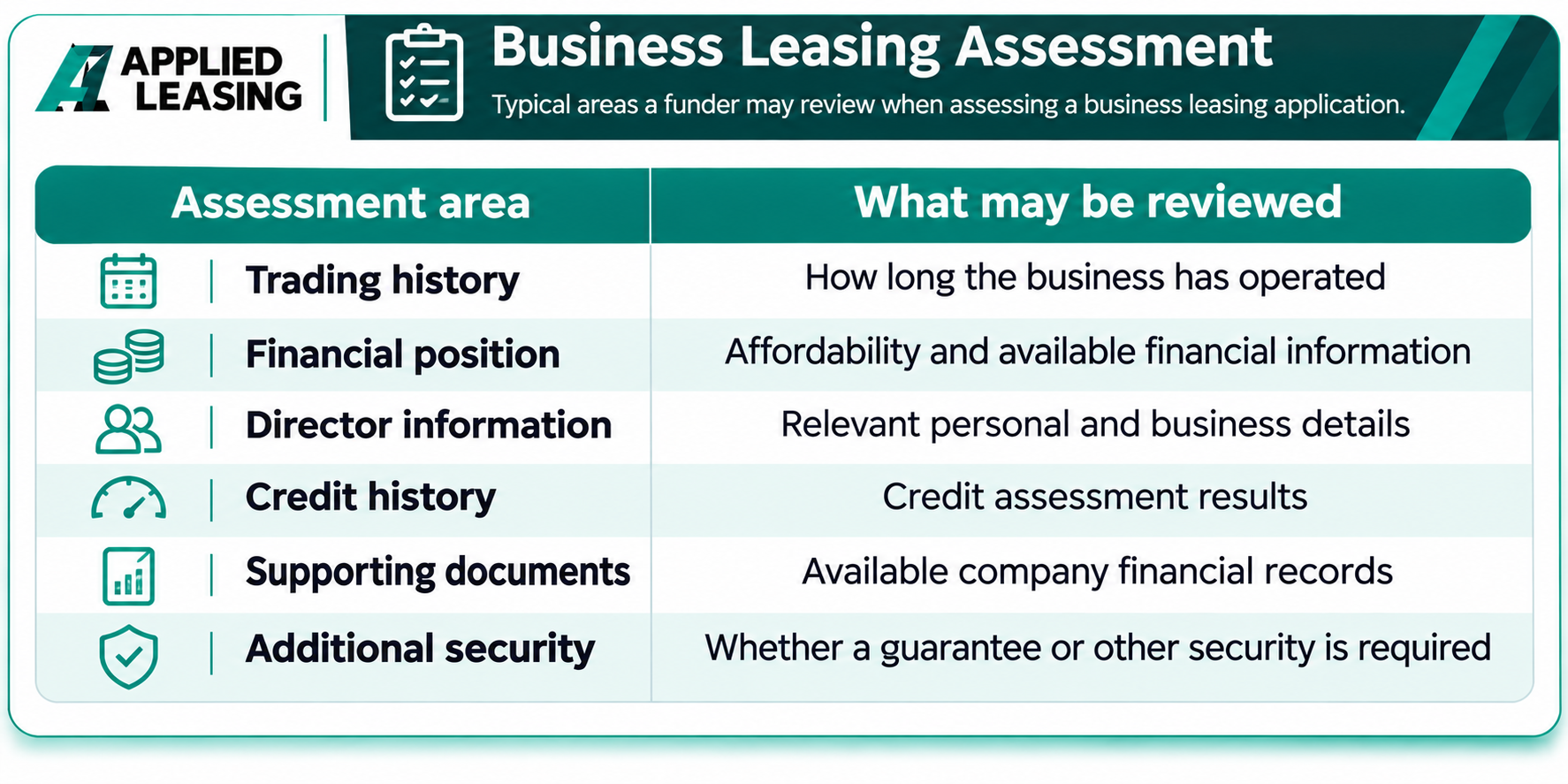
Being a new company does not automatically prevent you from applying, but acceptance is not guaranteed.
At Applied Leasing, our team can explain the information that may be required when making an enquiry and help you explore available business leasing options.
9. What Costs Should Businesses Consider Beyond Tax Relief?
Tax treatment is important, but it should not be the only factor in choosing a vehicle.
Business Leasing Cost Checklist
-
Initial rental and subsequent monthly rentals.
-
Administration or broker fees.
-
Insurance.
-
Maintenance and servicing.
-
Tyres and repairs.
-
Fuel or electricity.
-
Vehicle taxation where applicable.
-
Annual mileage and excess mileage charges.
-
Early termination provisions.
-
End-of-contract vehicle condition requirements.
A lease with an attractive monthly rental may not necessarily be the most cost-effective option once all relevant costs are included.
Applied Leasing insight: Compare vehicles using their expected total cost over the same contract term and mileage, including any tax treatment confirmed by your accountant.
For more information about the leasing process, read our Step-by-Step Leasing Guide.
10. Frequently Asked Questions About Business Car Leasing Tax
Can I claim 100% of business car lease payments against Corporation Tax?
Qualifying rental expenses may be fully deductible from taxable profits where the relevant conditions are met. A 15% restriction can apply to certain higher-emission cars.
A full deduction does not mean the business receives the entire rental cost back in tax savings.
Can I reclaim VAT on a business lease?
Eligible VAT-registered businesses can normally recover 50% of the VAT on qualifying car rentals where private use is permitted.
Full recovery may be possible in certain circumstances, subject to strict conditions.
Are electric cars better for company car tax?
Fully electric company cars benefit from relatively low BiK percentages, although these rates are scheduled to rise.
The overall tax position depends on the vehicle and individual circumstances.
Does a company director pay BiK on a leased car?
A director may have a taxable company car benefit if the vehicle is available for private use.
The tax treatment depends on the circumstances, not simply whether the vehicle is leased or purchased.
Can a business lease a car used for personal journeys?
Yes, subject to the finance agreement and insurance arrangements.
However, private use can affect VAT recovery, company car tax and the overall tax treatment.
Is the administration fee tax-deductible?
A business-related administration or broker fee may be deductible, subject to the applicable tax and accounting rules.
The treatment of VAT should also be checked.
Is leasing a van treated the same as leasing a car?
No. Vans can be subject to different VAT, expense and employee-benefit rules.
Businesses should check how the vehicle is classified for tax purposes.
Can I lease more than one vehicle through my business?
Potentially, yes.
Approval depends on the finance provider's assessment, affordability and the company's circumstances.
11. Our Verdict: Are There Tax Benefits to Business Car Leasing?
Business car leasing can offer valuable tax advantages for eligible UK businesses, but the benefits depend on the vehicle, its use and the company's tax position.
VAT-registered businesses may be able to recover some of the VAT on lease rentals.
Qualifying rental expenses may reduce taxable profits, subject to restrictions.
Fully electric company cars can also offer relatively favourable BiK treatment for employees and directors.
However, tax relief should be considered alongside the total leasing cost, cash flow requirements and suitability of the vehicle.
Businesses should discuss their specific tax position with a qualified accountant or tax adviser before entering a leasing agreement.
12. Explore Business Car Leasing with Applied Leasing
Looking for Your Next Business Vehicle?
Applied Leasing has been helping UK businesses and motorists explore vehicle leasing options since 1990.
Whether you operate a small business, manage a company fleet or are considering an electric company car, our team can help you compare available leasing options.
Explore our services:
Looking for your next business vehicle? Explore our latest Business Contract Hire offers or speak to an Applied Leasing specialist about a contract that suits your business requirements.
Applied Leasing Limited is a credit broker, not a lender. Applied Leasing Limited is an Appointed Representative of Jurni Limited, which is authorised and regulated by the Financial Conduct Authority for credit broking activities. Finance is subject to status and terms and conditions.
Official Sources and Further Reading
Information reviewed on 17 November 2026. Tax treatment depends on individual circumstances, and future measures may be subject to legislation. Examples are illustrative and are not quotations or personalised financial or tax advice. Consult a qualified accountant or tax adviser before making decisions.